EN
EN

How Hydraulic Presses Work: Pascal’s Law and Force Amplification
Understanding Pascal’s Law and Fluid Pressure Transmission
The basic idea behind hydraulic presses comes from something called Pascal's Principle. Basically, when we apply pressure to a liquid trapped inside a system, that pressure gets passed around evenly throughout the whole thing. Take a look at how these systems work in practice. When someone pushes down on a small piston area what happens next? The fluid gets compressed and sends that same pressure through the lines right over to a bigger piston area. And here's where things get interesting. There's actually a simple math connection between the sizes of those pistons and the amount of force they can create. A tiny push on one end translates into something much stronger on the other side because of this area difference. That's why even relatively weak inputs can result in really powerful outputs in hydraulic systems.
Force Amplification Mechanism in Hydraulic Systems
The force amplification process hinges on surface area differentials between pistons. A 10:1 ratio between slave and master cylinder areas multiplies output force tenfold while proportionally reducing movement distance. This tradeoff adheres to energy conservation laws while enabling heavy-duty forming operations impractical for mechanical systems.
Role of Master and Slave Cylinders in Force Multiplication
Master cylinders initiate pressure, while slave cylinders amplify force. Precision-machined surfaces maintain fluid integrity, with check valves preventing backflow during compression cycles. This pairing forms a closed-loop system where <5% energy loss occurs through friction and heat dissipation (Parker Hannifin, 2023).
How Hydraulic Pressure Enables High-Efficiency Metal Forming
Hydraulic pressure’s omnidirectional nature ensures uniform force distribution across complex die geometries. This eliminates stress concentrations common in mechanical stamping, reducing material fatigue by up to 40% in deep-drawn components per ASM International standards.
Core Components and System Integration in Hydraulic Press Machines
Hydraulic Cylinder, Pump, Valves, Reservoir, and Fluid System
Every hydraulic press relies on five key parts working together. First off, the hydraulic cylinder takes fluid pressure and turns it into actual mechanical force. Gear pumps or piston pumps handle the job of moving fluid through the system at speeds reaching around 300 liters per minute. Then there are directional control valves which keep everything running smoothly by managing pressure levels and directing flow paths with pretty good accuracy (about +/- 1.5%). These valves make sure metal gets formed just right during manufacturing processes. Most presses come equipped with reservoirs ranging from 50 to 200 liters that help maintain proper fluid levels and stable temperatures. They also include filtration systems capable of trapping nearly all contaminants larger than 10 microns. Lastly, the hydraulic fluid itself serves two main purposes: transmitting power throughout the system and acting as a coolant. For best results, most operators stick with ISO VG 68 grade oil when temperatures stay between 40 and 60 degrees Celsius according to recent industry standards.
Integration and Synchronization of Hydraulic Components
Today's modern presses hit around 92 to 97 percent system efficiency thanks to components working together in harmony. When it comes down to it, the pump output matches up with what the cylinder needs at any given moment through those proportional valves we see everywhere these days. And don't forget about those pressure compensators that tweak flow rates pretty much instantly, usually within just a tenth of a second or so. What makes all this possible is the ability to modulate force continuously across an incredible range from as little as 50 kilonewtons right up to massive 50,000 kN forces. This kind of versatility matters a lot for different industries. Think about small scale stuff like making intricate jewelry versus heavy duty tasks in aerospace manufacturing where precision counts for everything. The system also keeps things running smoothly because temperature sensors in the reservoir constantly talk back to the pump controllers. This prevents problems like cavitation and thermal throttling that could otherwise bring operations to a grinding halt.
Maintenance and Performance Optimization of Key Parts
A three-tier maintenance strategy extends component lifespan by 40–60%:
- Daily inspections of fluid levels and filter saturation
- Quarterly pump efficiency tests using ultrasonic flow meters
- Annual cylinder rod polishing to maintain surface roughness below 0.4 µm Ra
Leak detection systems using 25-psi threshold alerts reduce fluid waste by 18%, while predictive analytics forecast seal replacements 200–400 operating hours before failure. Adhering to preventive maintenance protocols minimizes unplanned downtime and maintains ±0.4% – 0.8% force consistency across production cycles.
Core Components and System Integration in Hydraulic Press Machines
Integration and Synchronization of Hydraulic Components
Today's modern presses hit around 92 to 97 percent system efficiency thanks to components working together in harmony. When it comes down to it, the pump output matches up with what the cylinder needs at any given moment through those proportional valves we see everywhere these days. And don't forget about those pressure compensators that tweak flow rates pretty much instantly, usually within just a tenth of a second or so. What makes all this possible is the ability to modulate force continuously across an incredible range from as little as 50 kilonewtons right up to massive 50,000 kN forces. This kind of versatility matters a lot for different industries. Think about small scale stuff like making intricate jewelry versus heavy duty tasks in aerospace manufacturing where precision counts for everything. The system also keeps things running smoothly because temperature sensors in the reservoir constantly talk back to the pump controllers. This prevents problems like cavitation and thermal throttling that could otherwise bring operations to a grinding halt.
Maintenance and Performance Optimization of Key Parts
A three-tier maintenance strategy extends component lifespan by 40–60%:
- Daily inspections of fluid levels and filter saturation
- Quarterly pump efficiency tests using ultrasonic flow meters
- Annual cylinder rod polishing to maintain surface roughness below 0.4 µm Ra
Leak detection systems using 25-psi threshold alerts reduce fluid waste by 18%, while predictive analytics forecast seal replacements 200–400 operating hours before failure. Adhering to preventive maintenance protocols minimizes unplanned downtime and maintains ±0.1% – 1.5% force consistency across production cycles.
H-Frame and C-Frame Hydraulic Presses for Small-Scale Operations
The H frame hydraulic press has this nice open front design with quick tooling changes perfect for prototyping or short runs in small-scale operations. And then there are C-Frame models which occupy less space yet deliver accurate part alignment valuable for tasks like bearing installations or assembling intricate machinery parts. Both types serve well in small job shop settings due to their ease and flexibility during diverse manufacturing processes. An examination of industrial pressing equipment reports from 2022 revealed that two-thirds of the usage in small-scale metal forming industries involve these H and C-frame presses, underscoring their popularity for smaller operations.
Four-Column and Roll-Frame Presses for Heavy-Duty Forging
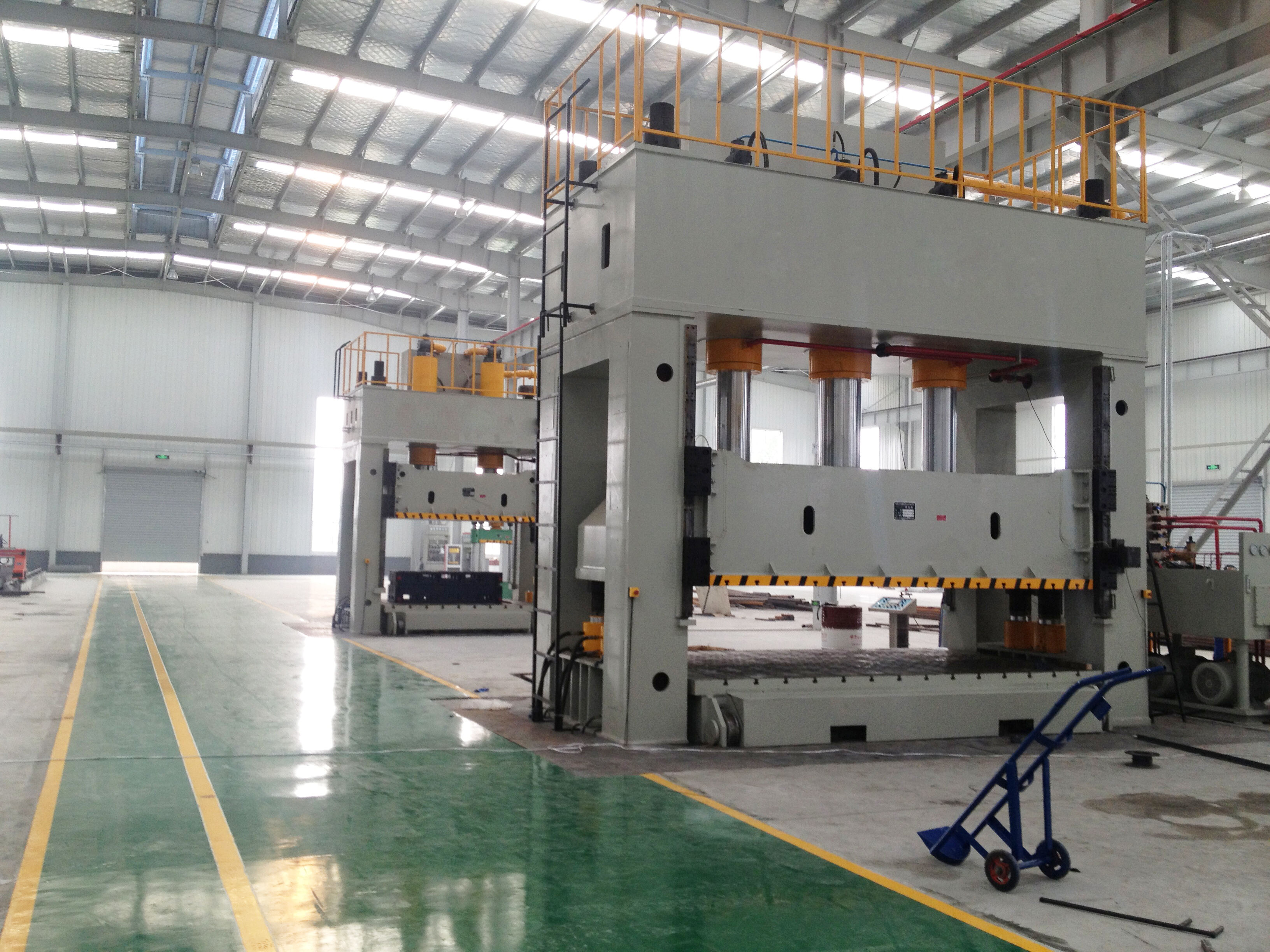
When it comes to heavy duty stamping, machines like four-column presses are top-notch choices. Unmatched by other types, these presses spread pressure uniformly, preventing any shape deformation in massive workpieces when forming operations get intense. Their incredible force capacity—sometimes exceeding 50,000 tons—makes them perfect for tough tasks that demand both raw power and precision. Roll-frame presses, on the other hand, offer even pressure distribution crucial for demanding applications involving stringent dimensional tolerances, such as components produced for critical sectors like aerospace engineering.
Straightening Presses and Specialized Variants
Straightening presses effectively correct deformities in longer pieces such as shafts, beams, or irregular welded components by using disciplined incremental pressure adjustments. Through these customizable dies, operators can achieve precise sweet-dimensional positioning without accidental bending incidents. Process controls regulate every aspect of force application live through modern IoT platforms, ensuring high accuracy and reliability when it matters most. Variants like hot-forming machines meet specialized automotive chassis fabrication challenges by accommodating extremely tough materials requiring dedicated die thermal management features.
FAQ Section
What is Pascal's Law, and how is it applied in hydraulic presses?
Pascal's Law states that pressure applied to a confined fluid is distributed evenly throughout the fluid. In hydraulic presses, this principle allows force applied on a smaller area (the master cylinder) to be amplified when transferred to a larger area (the slave cylinder), resulting in significant force multiplication.
What are the main components of a hydraulic press system?Hydraulic presses consist of five primary components: the hydraulic cylinder, pump, valves, reservoir, and the hydraulic fluid system. Each part plays a crucial role in converting fluid pressure into mechanical force.
How does a hydraulic press improve efficiency in metal forming?Hydraulic presses allow for precise force control and even pressure distribution over forming dies. This reduces the chances of material stress and thinning defects, enabling manufacturers to work with complex shapes and brittle alloys efficiently. They also consume about 40% less energy compared to mechanical presses.
What is the force amplification mechanism in hydraulic systems?Force amplification in hydraulic systems is achieved through the surface area differentials between master and slave cylinders. A larger surface area in the slave cylinder compared to the master cylinder multiplies the output force while reducing the movement distance, in adherence to energy conservation laws.
What maintenance strategies are recommended for hydraulic press machines?A three-tier maintenance approach is recommended: 1) Daily inspections of fluid levels and filter saturation, 2) Quarterly pump efficiency tests using ultrasonic flow meters, and 3) Annual cylinder rod polishing to maintain optimal performance and extend the component lifespan by 40–60%.